
Tap to enlarge
David Irving
Apocalypse 1945: The Destruction of Dresden
⏱️ ~8 hours·📖 320 pages·📅 Published 2025·⭐ 4.9 (1 review)
Apocalypse 1945: The Destruction of Dresden was first published on April 30, 1963. Using official papers, private records, and the accounts of eye-witnesses on both sides. David Irving gives a harrowing account of the two saturation bombing raids executed by RAF Bomber Command on Germany's most beautiful city at the end of the war, a horrific firestorm raid which left over 100,000 innocent civilians dead or missing-jacketed
Format
320 pages · 6" × 9" · Jacketed hardback
Also Available As
HardcovereBook$25.00
Hardcover·320 pages
$54.00
Ships next business day
Notify me when available
Secure Checkout
Ships Worldwide
30-Day Returns
We accept
₿ Crypto Accepted
Apocalypse 1945: The Destruction of Dresden is first published on April 30, 1963. At 10 p.m. on February 13-14, 1945, the Master Bomber broadcast the cryptic order: ‘Controller to Plate-Rack Force: Come in and bomb glow of red T.I.s as planned.’ The ill-famed R.A.F. attack on Dresden had begun. The target city was among Germany’s largest but had little military or industrial value. It was a centre for evacuating wounded servicemen, and schools, restaurants, and public buildings had been converted into hospitals.
The authorities expected that this, a city often compared with Florence for its graceful Baroque style, would be spared. By 1945, the legend was deeply entrenched that Dresden would never be bombed. It was not to be.
In February 1945, with the war’s political and military directors meeting at Yalta in Crimea, Mr Winston Churchill urgently needed some display of his offensive strength and willingness to assist the Russians in their drive westwards. Just seven miles behind the eastern Front, Dresden became the victim of Mr. Churchill’s desire for a spectacular ‘shattering blow’. As things turned out, this, the most crushing air raid of the war, was not delivered until the Yalta conference ended.
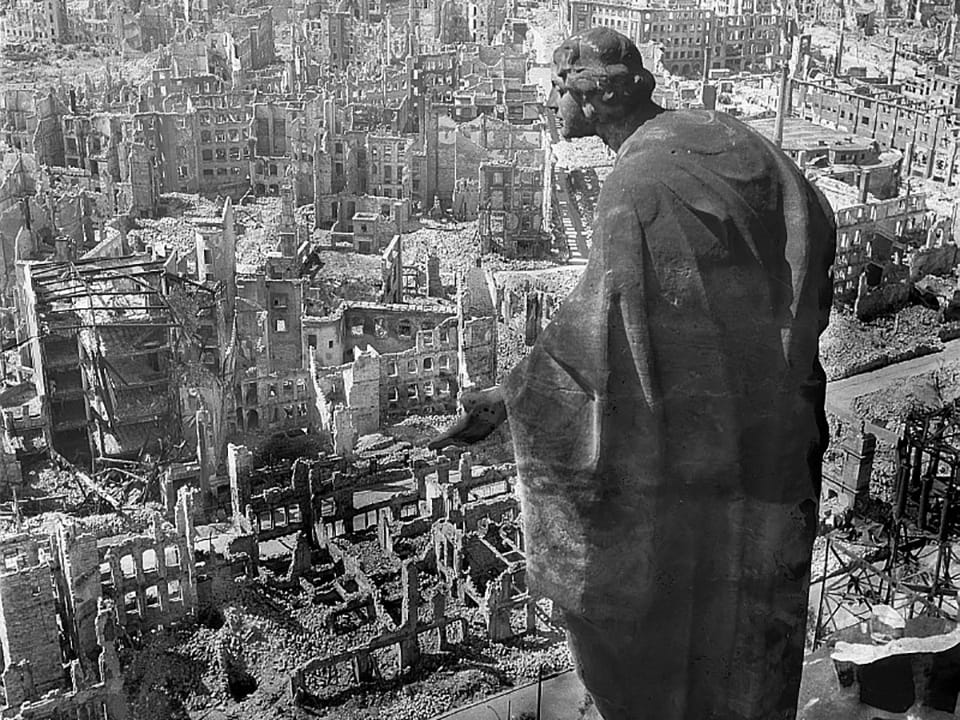
The city was undefended - even the Luftwaffe’s local night fighter force was grounded. There were no proper air raid shelters. Dresden was housing hundreds of thousands of refugees from Silesia, East Prussia, and western Germany, in addition to its population of 630,000. Up to a hundred thousand people, perhaps more, were killed in two or three hours, burned alive that night. Yet until the first edition of this book appeared in 1963, the raid scarcely figured in the Allied war histories. A veil had been drawn across this tragedy.
Stung by foreign revulsion at this new St Valentine’s Day massacre, the British prime minister - who had ordered it - penned an angry minute to his Chief of Staff, even before the war ended, rasping that ‘the destruction of Dresden remains a serious query against the conduct of allied bombing’. It is from this remarkably forgetful minute that the sub-title is taken. For the first time, the full story, omitting nothing, of the historical background to this cruel blow and of its unexpected political consequences, is told.
320 pages - Hardback
About the Author

David Irving
David Irving is a renowned British historian and author of over 30 books. Known for his meticulous primary source research, he has spent decades in archives across the globe, unearthing diaries, documents, and first-hand accounts that have reshaped our understanding of the Second World War and its key figures.
View all books by David IrvingGet Notified About New Editions
Be the first to know about new releases, exclusive offers, and archive discoveries.
From the Archive
Reading Guide
The Definitive David Irving Reading Order
Not sure where to begin with David Irving's works? This guide maps out the ideal reading order — from the essential starting point of Hitler's War through Churchill, Rommel, Nuremberg, and beyond.
From the Archives
5 Documents That Rewrote World War II History
From forgotten adjutant diaries in German attics to microfiched diaries in Moscow archives, these five documentary discoveries by David Irving fundamentally changed what we know about the Second World War.
You May Also Like

Sale
Generation 68: The Elite Revolution and Its Legacy
Kerry R. Bolton · Hardcover · 320pp
$27.89$32.00
Ships in 24–48h

Hess: The Missing Years 1941-1945 (eBook)
David Irving · eBook · 403pp
$14.00
Ships in 24–48h

The War Path: Hitler's Germany 1933-1939 (eBook)
David Irving · eBook · 328pp
$20.00
Ships in 24–48h

Pre-order
The Destruction of Convoy PQ-17
David Irving · Hardcover · 412pp
$34.00